Monday

Never The Same River (Possible Futures, Probable Pasts) Selected by Simon Starling


This show displays past works from Camden Art Centre exhibitions. The pieces have been positioned the way they were in their original showings, which for some is up to 50 years ago. From this point of departure, Simon Starling, the 2005 Turner prize winning artist and former Camden Art Centre resident, has selected new works by artists in a predictive look at the Centres future direction.

Walking round Never The Same River (Possible Futures, Probable Pasts) is a kind of archaeological experience. One feels as though the works act as much like artefacts as they do typical Modern art works. Due to its presentation, Starling has been able to create the sensation of a museum. An historical line drawn from high modernist designs and forms, evident in works like Mary Martin’s Maquette (1956; originally produced for This is Tomorrow which took place at the Centre in that year, and is currently being much celebrated at the The Whitechaple Gallery); Isokon Furniture display shown at the gallery in the Thirties and Erno Goldfinger’s Trellick Tower (1972).

From these simple, clean shapes so synonymous with early western twentieth century art and design, we are carried through a variable array of time signifiers, and horrors, of the last century: Andrea Fisher‘s Displacement I (Hiroshima) (1993) and Bacon’s Figure Study II (1945-46) are two such images which share this displaced dialogue, commenting on the sheer repulsion of a war torn age.

The exhibition leads us from the centres archival exhibits, towards a reassessment and reordering of recent western history. Works such as Sean Lynch’s Delorean Progress Report, Matthew Buckingham’s False Future (2007) Graham Gussin’s Fall (7200-1) and Francis Upritchard’s Sloth with Roman Plastic’s (2005), seem most effective at presenting the viewer with an appraisal of the activities of the post colonial age through artistic and creative alterations.

The focusing on time, and how artworks perhaps endure or ‘expire’ due to it, is a major theme of this show. However how we understand historical change through art and its varying forms is significant when appreciating this exhibition.

Never The Same River (Possible Futures, Probable Pasts) is on at the Camden Arts Centre from the 16th December 2010 - 20th February 2011.

Philippe Parreno at the Serpentine Gallery

© 2010 Philippe Parreno  Philippe Parreno, Invisibleboy, 2010, Film still, Courtesy of Air de Paris, Courtesy of Centre National des Arts Plastiques, © 2010 Philippe Parreno.

  Philippe Parreno, June 8, 1968, 2009, Film still, Courtesy of Pilar Corrias Ltd.,                © 2010 Philippe Parren

Some of you may already be familiar with the French-Algerian artist, Philippe Parreno. In 2006 he collaborated with the Scottish artist Douglas Gordon on their highly regardedZidane – A 21st Century Portrait", a film about the world renowned footballer Zinedine Zidane. Parreno is best known for his collaborative work. He has spent much of his career working with artists, musicians and film makers. His show at the Serpentine Gallery is in fact his first solo show in UK.


The exhibition consists of a handful of installations and four films which are shown in succession, on a loop throughout the day. This layout means that Parreno makes the viewer follow a certain pattern, which helps shape the interpretation of the exhibition.

The first film to be shown is Parreno’s latest picture: Invisibleboy (2010). This tells the story of a small Chinese boy who is an illegal immigrant in New York’s Chinatown. The boy survives by creating a fantasy world filled with gigantic make-believe creatures. This imaginary world exists parallel to the films social documentary form. As the title suggest, the boy, just as the monsters he creates aren’t supposed to exist, yet the issues surrounding this subject clearly do.

The question about existence follows us into the next screening. We are led into the centre space of the gallery. This short film is titled film June 8, 1968 (2009). It takes us on a journey from New York to Washington DC and visually depicts the route taken by Robert Kennedy’s body. The only sound we can hear is a trains familiar creaking and shunting. These sounds and images create a biblical atmosphere. The film is an uncanny view of a funeral cortège - a unique last journey, where what the viewer sees has become the film’s main focal point.

Next follows one of Parreno's early films about a school demonstration in Nice entitled No more reality (1993). Here we repeatedly hear school children shouting "no more reality", but the brightness is so overwhelming it becomes hard to see them. This film stands in sharp contrast to Parreno's fourth and final film TheBoyfromMars (2003). This film differs from the previous screenings because of its changing subjects. TheBoyfromMars may have little in common with the other films, as regards to its visual content. Nether the less, psychologically it evokes the same kind of feelings.  This includes a subject which is constant throughout the exhibition: humanity. All the films have the ability to pose questions about the links between dream, existence, reality and invisibility. Parreno adds further substance to these questions with the installation of snow, falling slowly on the east side of the Gallery. The dreamlike atmosphere is all around us when entering Philippe Parreno’s world and it is easy to be captured by it.

Exhibition #3 at the Museum of Everything

Britain has an eccentric past. Evidence of this can be seen in some of the little known toy museums, fun fairs and sea side resorts around the country; much of which have been forgotten about. In Exhibition #3 we get a chance to witness some of the United Kingdom’s ‘unconventional’ past. The exhibition gives us a view of the ‘bazaar’ and true British oddities. On display are fun fairs, art works, the so called ‘circus freaks’, peculiar taxidermy and other such overlooked ‘art forms’. The Exhibition was opened for two months from October last year but has re-opened for another month from January the 5th.


Exhibition #3 is a collaboration between Sir Peter Blake and the Museums of Everything’s James Brett. Brett like Blake is a great collector of these strange artifacts and fascinated by them. The Underlying idea is to display non-traditional art by untrained artists. Things like taxidermy and the work of fairground painters take centre stage in this exhibition. The displays consist of Blake’s own collection, but he has also borrowed pieces from other collectors.
What really makes Exhibition #3 a memorable experience is how the works interact with each other within the exhibition space. Every inch tells a story, but instead of becoming overcrowded it creates an unusual intimacy and an overall sensation of a lost world.

Already at the entrance you feel like you are entering a world from a bye gone era. The exhibition starts by taking us through a narrow passage full of photos of Victorian 'circus-freaks'. After that we get introduced to a vast variety of British eccentricity, seen in the shell sculptures, puppet theatres and fairground memorabilia. On the second floor what is displayed is the wicked world of Walter Potter's extraordinary taxidermy. His work displays boxing rats, the world smallest dog and a two headed lamb, to name but a few.
Ted Willcox’s work stands out. He (according to Blake) was a 2nd World War rear gunner, who spent his later years embroidering art works; mostly depictions of female ‘pin-ups’. The girls have been given strangely colorful backgrounds and some of them have their arms full of tattoos. Whether appreciated or not, unique they are.
On the whole it is refreshing to see a part of British history, usually overlooked, get dusted off and exhibited in such an interesting and suitable way.

The disappointment of ‘First Thursday’ the 3rd of February & the delight of Clarisse d’Arcimoles


DSC_0087

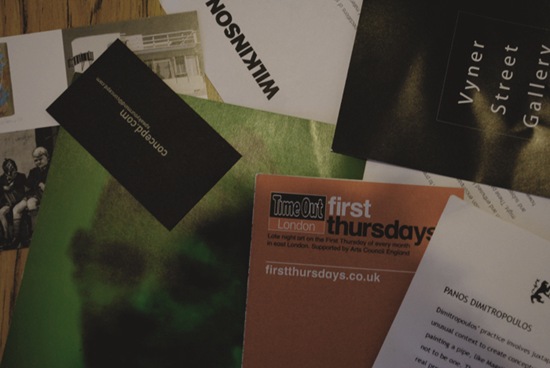
First Thursday (3rd of Feb) in Vyner Street was as busy as I expected. The intention of this visit was mainly to see the show, in conjunction with The Salon Photo Prize, at the Matt Roberts Gallery; a much applied for and subscribed to event. Although I would have liked to have written a piece which detailed this opening, this will be impossible on this occasion. I am sure that there was some interesting work on display (images by Emma Crichton, Ben Gold and Rachel Wilberforce still managed to catch the eye under these disappointing circumstances). However due to the nature of the layout, size of the gallery, the number of works and the undoubted popularity of this exhibition it was unattainable; and totally intolerable to look at and properly assess the work. Having been given the impression that this was a prestigious photo exhibition I was certainly surprised just how poor the Matt Roberts Gallery space was. It did little justice to the 39 artists and their photographs, as you could barely get into the gallery. Subsequently it seemed like a ‘two in, two out’ policy was being conducted at the door. Furthermore it had said in the original ‘call for entries’ description that 100 artists would be selected. Maybe their lousy track record on all things numeric can also account for the fact that with 39 photographers displaying their prints in the gallery meant that it was absolutely overloaded with images. God help us if they had been honest and stuck to their original number of 100. Finally its also worth considering whether just so many artists, who remember had to pay to applied for this competition, would have if they had known just what kind of show they were going to end up in before hand?

Now that this is established, and removed from my chest; I will go on. From the initial disappointment which was The Salon Photo Prize, came real joy. This pleasure came in the form of the French photographic artist Clarisse D’Arcimoles. An artist I had only heard of once previously, when I saw her piece Rise and Fall in the free newspaper produced by a few months ago. I had remembered appreciating this work at the time, even if only fleetingly so.

A relatively new, young artist this is Clarisse’s debut solo show in London and takes place at HRL Contemporary galley; 12A Vyner Street. Although new, Clarisse is clearly fast making a name for herself; she is currently exhibiting at the Saatchi Gallery and Newspeak: British Art Now Vol II. The work at HRL is a collection of recent projects, its full title being: Clarisse d’Arcimoles: Un-Possible retour and Other Recent Works. The works include a series of images which are reconstructed from childhood family snaps. They are displayed alongside the original source images. Both funny and often moving these photographs work, like much of the images in this show, on a fundamental human level. What is striking to me is the tremendous physical similarities individuals have to their childhood; and in some cases even infant, appearances’. As Diane Arbus made clear the profound differences between identical twins, it seems d’Arcimoles is also able to highlight another overlooked aspect of the human physical form.

The other piece of significance is The Good Old Days (the series I had previously only ever seen in paper.) This project, a continual work, was an investigation into the life and times of Jimmy Watts, the oldest resident of the Market Estate in Holloway. The estate was demolished last year and d’Arcimoles displays the pages of her workbook which was used when planning and documenting this project. In this we see a collection of family snaps and personal photos of Jimmy and the estate, and unique documentation from his time living there. This work was also used to show the preparation for a film which Clarisse has made about this subject. An installation of a darken room is presented here. This is of a starkly illuminated old office with paper documentation every where and an old type writer on a desk; a ghostly experience, this setting further adds to the works profound sense of loss and history. What we see here is one man’s life presented to us through a variety of images and words. But also the existence of a whole housing scheme and a certain period in British history, and a way of life associated with this. Consequently the real strength of Rise and Fall is how it brilliantly combines the personal with the collective in that respect.

Clarisse’s film will be shown in a reconstruction of how it was screened in Jimmy’s flat before it was knocked down.

More details on the show can be found here: hrl contemporary

 DSC_0039  DSC_0049 DSC_0022 DSC_0057 people line1 line2 line3  line5DSC_0063